
Gallatin R-V School District Places $5.85 Million Bond Proposal on April 7 Ballot
Gallatin, MO- The Gallatin R-V School District is asking voters to consider a $5.85 million bond
proposal on the April 7 ballot to address overcrowding, safety, and facility needs across the district.
If approved, the bond would fund:
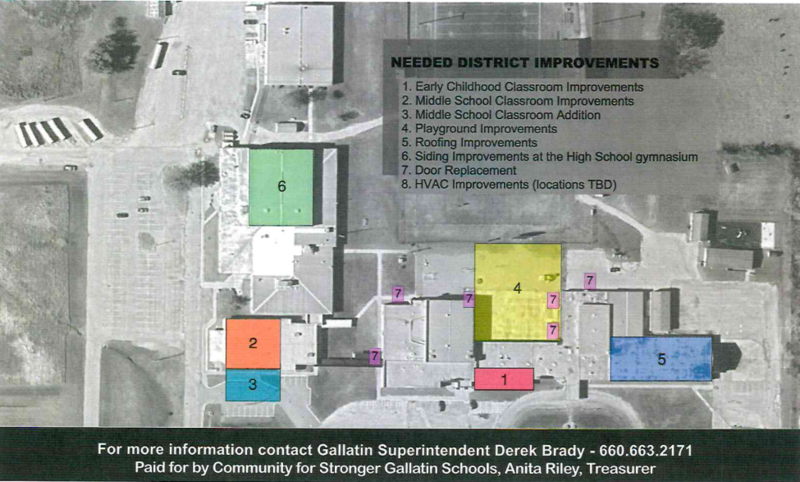
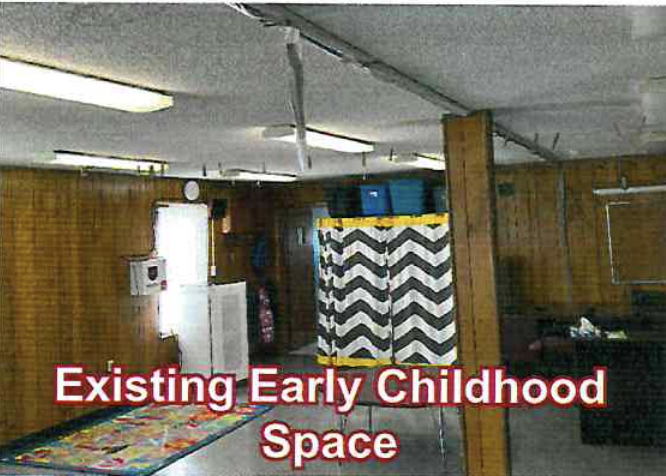
Relocation of preschool and early childhood programs into the main elementary building
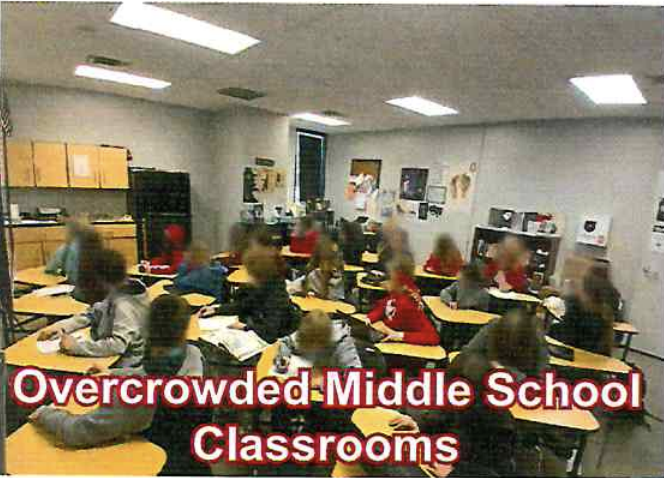
Renovation and expansion of middle school classrooms
Safety upgrades, including secure entry improvements
Repairs and replacement of roofs, HVAC systems, and siding
Elementary playground additions and improvements
Additional facility upgrades as funding allows
The district's operating budget covers daily expenses such as salaries, utilities, and routine maintenance but cannot support large-scale capital improvements. Bond funding is the voter-approved method used to complete major facility projects and is restricted to construction, renovation, and infrastructure needs.
Many needs are time-sensitive due to aging infrastructure. Delaying repairs could increase costs and lead to further deterioration. Addressing these issues now allows the district to improve safety, reliability, and learning environments for students and staff.
If approved, the bond would result in an estimated tax increase of $0.70 per $100 of assessed valuationapproximately $11.08 per month for a home appraised at $100,000 by the assessor. Funds would be used exclusively to repay the bonds.
Most projects are expected to be completed during summer 2026, with remaining work finalized during the 2026-27 school year.
The April 7 ballot asks voters to authorize the issuance of general obligation bonds to support these improvements as part of the district's commitment to safe, high-quality educational facilities.
What is on the ballot?
The Gallatin R-V School District is asking voters to consider a $5.85 million bond proposal to address overcrowding, facility, safety, and maintenance needs across the district. The measure would provide funding to replace or repurpose space for early childhood education, enhance and expand middle school classrooms, make safety upgrades, playground improvements, and complete building improvements at the elementary, middle, and high school facilities.
Why are the bond issue funds needed?
The District operates on a balanced annual budget that primarily covers day-to-day expenses such as instruction, staff salaries, utilities, and routine maintenance. The scope and cost of the identified facility and safety projects are beyond what the existing operating budget can support. The bond issue, repaid through a $0.70 increase in the debt service property tax levy, is the tool available to generate the additional revenue needed to complete these long-term capital improvements.
Why Now?
The facility and safety issues have been building over many years and cannot be effectively managed within the district's regular operating budget. Many of the needs such as aging roofs, HVAC systems, doors, and other critical infrastructure are time-sensitive. Delaying major repairs or replacements can lead to more frequent breakdowns, higher maintenance costs, and further deterioration of buildings. Postponing these projects may also result in higher construction and material costs in the future, making the same work more expensive later. Addressing these items now allows the district to take a more proactive approach to facility safety, reliability, and learning environments for students and staff.
 Keeping Our Commitment to Safe and Quality Educational Facilities for our Community
What is a Bond Issue?
A bond issue is a traditional way for schools to borrow money to pay for major school maintenance and repair projects, such as adding security measures or upgrading deteriorating areas. Voter approval is needed to authorize the District to borrow the money.
What will the tax rate be?
If the bond issue passes, the District's debt service tax rate will be $0.70. The monthly impact would be $11.08 on $100,000 of residential property appraised value. The money generated by the debt service tax levy is then used to pay off the bonds.
Why aren't these expenses included in our operating budget?
Operating funds are used to support salaries and benefits, transportation costs, utilities, textbooks, and other supplies. Operating funds are used for maintenance and upkeep; however, there is little left for addressing deferred maintenance and major improvements.
Can the funds be used in any other way?
The money from bond issues can only be used for capital expenditures, such as building additions, repair, renovation, and certain technology costs.
If the bond issue passes, when would the work be done?
The majority of the work will be done during the summer of 2026 in time for the return of students in August, with the balance being completed during the 2026-27school year.
Existing Conditions Example
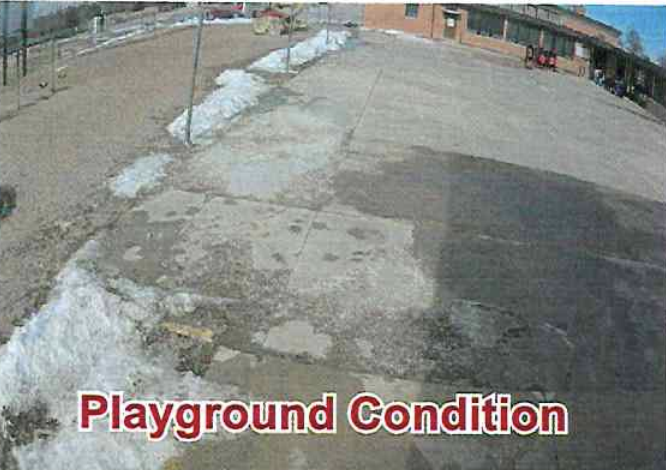
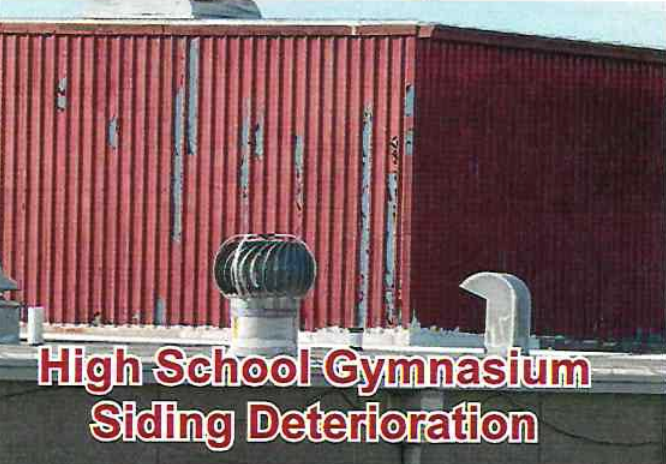
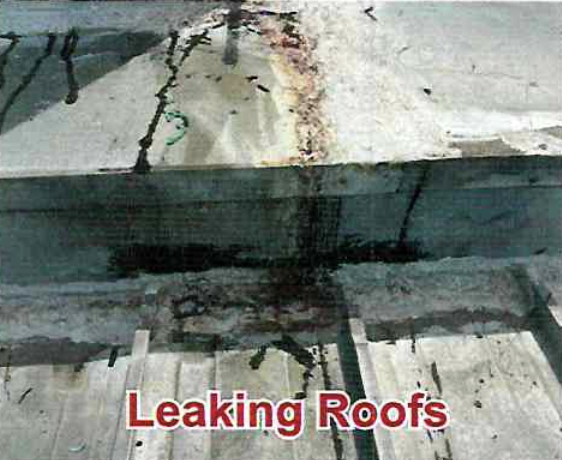
Proposition Gallatin Schools
Shall the Board of Education of the Gallatin R-V School District of Daviess County, Missouri, borrow money in the amount of Five Million Eight Hundred Fifty Thousand Dollars ($5,850,000) for the purpose of providing funds to replace and/or repurpose current facilities for early childhood education; to make enhancements to the Middle School, including renovation of existing and/ or construction of additional classrooms; to install new safe and secure doors, repair/replace roofing, upgrade the heating, ventilation, and air conditioning (HVAC) systems, and make playground improvements at the Elementary School; to replace/ repair siding at the High School Gym; to the extent funds are available, complete other repairs and improvements to the existing facilities of the District: and issue general obligation bonds for the payment thereof resulting in an estimated increase to the debt service property tax levy of $0.7000 per one hundred dollars of assessed valuation? If this proposition is approved, the adjusted debt service levy of the School District is estimated to increase from $0.0000 to $0.7000 per one hundred dollars of assessed valuation of real and personal property.